Millions of trees are planted every monsoon in India. Six months later, most of them are dead. And one uncomfortable question nobody in India's afforestation ecosystem wanted to ask what happens after the photo is taken?
 Rashmeet Kaur Chawla
Millions of trees are planted each monsoon in India. The states set ambitious afforestation goals, corporations organize CSR plantation campaigns, while children from schools plant small saplings in newly dug holes and get their pictures clicked. On paper, it all looks great. However, once you pass by these plantation sites six months later, you'll notice that most of these trees are either dead, crushed, eaten by stray cows, or have been totally ignored.
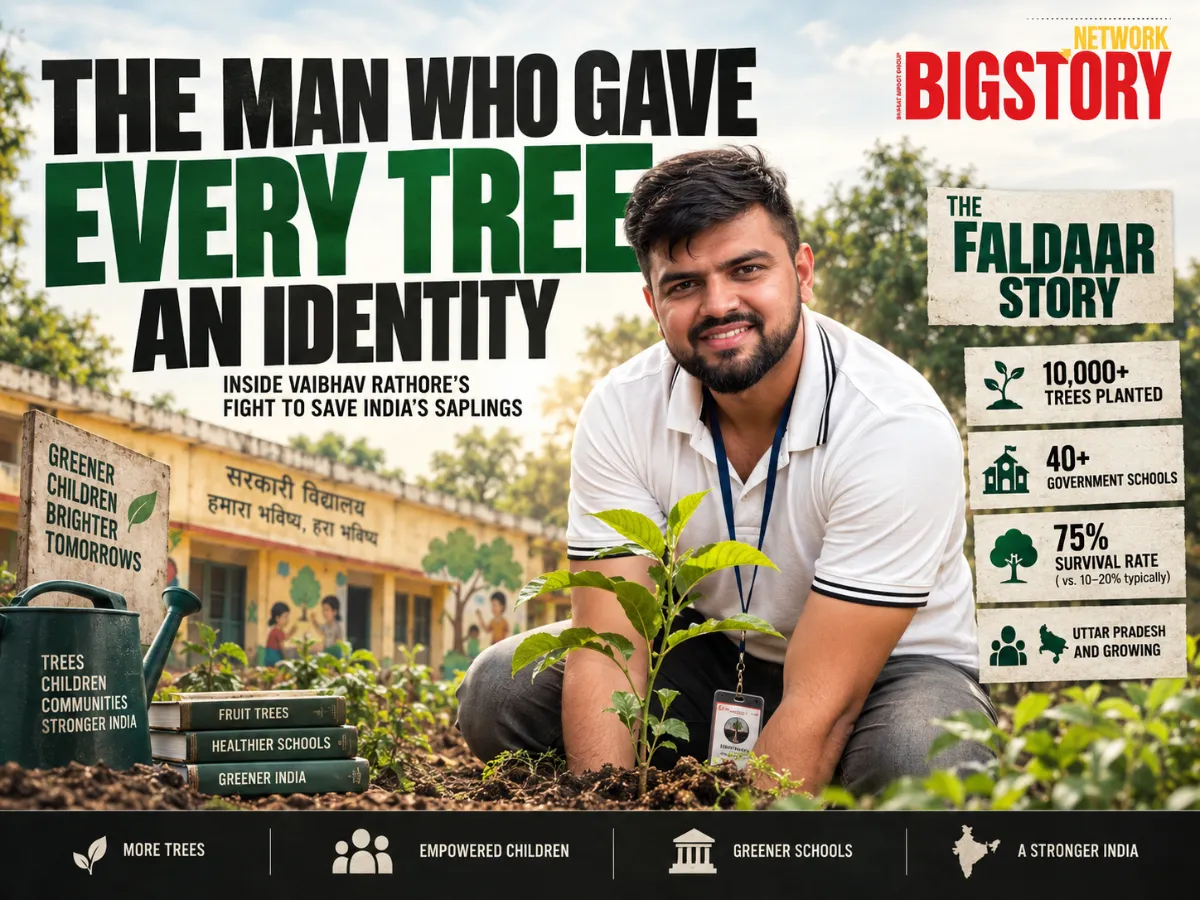
It was Vaibhav Rathore, an individual from the state of Uttar Pradesh who is 28 years old, who recognized the missing link here. Not the link between planting but the link of caring about these trees. Thus, he created an organization called Revamp India Foundation based on a seemingly simple idea.
This led to the creation of Faldaar, which is a program focusing on planting fruit trees and has now reached more than 40 government schools in Uttar Pradesh, where over 10,000 fruit-bearing trees have been planted with an amazing survival rate of almost 75 percent- something that is far higher than the usual 10-20 percent government survival rate.
Vaibhav Rathore is an Indian changemaker, who comes from Uttar Pradesh, and whose age is 28. In recent years, Vaibhav has been involved in the field that combines environment and education. Unlike others who consider tree plantation an isolated process, Vaibhav sought to create a system where survival would be more important than planting itself- beginning with government school children.
Revamp India Foundation is an NGO which operates within the realm of government schools in Uttar Pradesh and attempts to redefine afforestation in India. The NGO operates through its Faldaar program which does not go for mass plantation programs; instead, the NGO takes responsibility of trees into account and makes school children their guardians who look after these saplings on a daily basis.
The methodology of the Revamp India Foundation for Faldaar was not born in a boardroom or a policy document. It emerged through observation of plantation drives that failed in practice. Trees were planted with much fanfare in the month of July, ignored in September and died by the next summer. This hands-on experience became the cornerstone of the insight of the foundation into the shortcomings of Indian afforestation attempts. Not a lack of saplings, but rather a lack of relationships was the issue here.
Faldaar is based on experiential learning. Rather than subcontracting tree planting to contractors who would simply plant the trees and forget about them, Revamp India Foundation integrates tree planting drives in government schools, places where the children are already present every single day. The saplings receive their identity in the form of name, number, sometimes even small signs. Every child, or small group of children, receives personal responsibility for taking care of a particular tree.
It is the experience being designed. Rathore did not theorize about “community ownership” in the abstract; he simply designed a building where ownership could not fail to happen, since the same person watering the tree today will reap its fruit in the future.
The distinction between Faldaar and other one-off plantation efforts is that Faldaar takes the challenge of replicability seriously, the know-how needed for making something which tends to collapse when replicated work. Plantations undertaken through government schools are notorious for their ease of conception but difficulty in execution; the incentives for doing plantation tend to dry up the moment the photograph is taken at the plantation event.
Revamp India Foundation has overcome this by focusing on survival rates of trees as the key factor, rather than mere one-time charity. Revamp India keeps track of survival rates in the more than 40 schools it partners with, something that is unusual even for grassroot level environmental organizations in India. The 75 percent survival rate is no boast but a metric that can be improved upon.
Selection of the fruit-bearing trees is another instance where such quiet knowledge of incentives is shown. While a neem or gulmohar plant provides shade and aesthetics, a mango, guava, or jamun plant will provide a tangible reward in a few years. Such delayed gratification through tangible rewards will continue to keep the kids interested in their trees long after they have become bored with plantation day. It helps them connect with nature in a more meaningful way.
The main problem for Faldaar is not growing small saplings, it is in ensuring the survival of those planted. The wild animals pose one of the greatest dangers because they graze on young plants while the latter's roots do not get enough time to grow and become solid. In the absence of any safeguards, all of the efforts made by children at the school could disappear in just a few hours. At the same time, there is a serious lack of tree guards which protect the plants when they are still too young and defenseless.
The unpredictable weather also makes it difficult for trees to survive.
The monsoons come irregularly with either no rains at all or a sudden torrent of precipitation disrupting the necessary irrigation balance. The extended droughts dry the roots before they manage to grow while unseasonal heat waves can burn the saplings in a few days. Therefore, the survival of the trees during their first year largely depends on the efforts of people.
The partnership of Faldaar with government schools itself conveys an air of authority. Government institutions do not entrust their classroom and playground timings to any random NGO; rather, there needs to be experience, reliability, and purposeful intention apart from just a single event. That Revamp India Foundation has grown in reach to 40+ schools clearly implies that the foundation has gained incremental institutional credibility.
That credibility has been further reinforced through the foundation’s insistence that tree planting be not seen as a one-time event but something that becomes a part of routine activity at the schools. Thus, Faldaar does not present itself as a campaigner but rather as an institution.
The visibility of Rathore himself as a founder is another element that comes into play here: a young man from Uttar Pradesh who is working inside the state government’s own school system. The initiative is not coming from some organization that parachutes in with a plantation quota target in mind. It is a local effort to solve a local problem.
Certainly, the most telling mark of the reliability of Faldaar's initiative is the fact that it does not shy away from its mistakes. A 75 percent success rate is definitely impressive considering Indian standards, but it also means that a quarter of the trees planted fail to survive. And, according to Rathore and his team, the reason behind this is very specific: stray animals grazing young saplings and constant lack of tree guards simply put metal or bamboo cages to protect a sapling in the first years of its growth.
And this is the exact cause of the current fundraising effort launched by Revamp India Foundation. Instead of asking people for a general contribution for a general mission, the organization asks for ₹200 – just enough to buy one single tree guard for one sapling.
Such an honest form of fundraising that talks about what works (the 75%) and pinpoints exactly what does not work (the 25% lacking, mostly because of avoidable harm) is uncommon in the Indian NGO sector, where figures on impact come without explanation or disclaimers.
Ignore the economic and survival advantages and the true contribution of Faldaar will become apparent- it uses environmental efforts as a tool to create something else. Children participating in the project learn not only how to water a sapling; they learn how to take responsibility beyond a single task, how to cooperate with other children who are in charge of the same tree, and how to develop a bond with nature that is denied to many Indian kids in the cities and semi-cities.
A country where environmental education is limited by the chapters about deforestation and global warming in school textbooks needs something that textbooks cannot provide- real involvement in the process. A child who names a mango sapling and helps it to survive through two monsoons knows about the fragility of the environment better than any lecture ever would.
Faldaar's story is one of incomplete success – and that's exactly why it's worth watching. While ten thousand trees and 40 schools are a considerable accomplishment for a startup venture, it's very clear that the job is far from done. Problems like animal damage and tree guards still exist and they're solvable problems too.
As for those looking for ways to do more than admire Vaibhav Rathore's work, there are many of them out there, contributing ₹200 gets you a tree guard for one sapling, and the foundation is always open for volunteers who want to get involved with the school program directly.
The work that Vaibhav Rathore is doing with Revamp India Foundation is not merely another plantation drive with fancy marketing, it is an actual solution to a problem that nobody else in the Indian afforestation ecosystem even bothers to ask about: what's going to happen to the saplings after they're planted?
Each and every founder whose story appears in this section has taken a problem which everybody else accepted as normal and challenged it.
Challengers are not after perfect stories. We're after the middle 25%, the ₹200 which remains to be collected, the shift that no one is willing to cover. It's where the hard work of making something happen really begins.
It is through this series that we will share such stories, complete with statistics that both paint an appealing picture and those that paint a stark reality, complete with challenges that have yet to be met. But not because the struggle is inspirational, but because it is reality. And that is what makes the founders worth their salt.
We profile the builders. We back the challengers. We remain for the follow-through.
There are many such stories where a person rises from zero to hero. They are indeed fascinating stories, but after a while, they become cliché. This is what makes Vaibhav Rathore's story unique and that is why we wanted to share his story with you.
The difference between this story and other zero to hero stories is not just in one man becoming successful.
What makes this story truly remarkable is how the idea was built to survive after this man, the model that links the effect on the environment to human interaction. Faldaar does not just plant trees. They connect a child to a tree seedling, a school to the environment around it and a generation growing up with climate anxiety to an opportunity to make a change.
That is what this story is really all about. This is not the story of the accomplishments of one man, but rather the blueprint of an actual model for environmental success through accountability, not one-off efforts. A tree does not live because it was supposed to according to policy; it lives because the child visited that tree in the morning.
The reason why we chose this story is that India does not need any more plantation campaigns. India needs more models of accountability that would make people, especially the younger generation, feel responsible for the result of their actions. And this is what Faldaar provides.
 Exclusive Content




Sign up for the Daily newsletter to get your biggest stories, handpicked for you each day.


 Trending Now! in last 24hrs